
Start with the numbers instead of the hype: AI startups in the UAE secured $519 million in 2025 — 60% of the entire MENA region’s AI funding for the year, and a 267% jump from 2024. In April 2026, the UAE’s Ministry of Economy launched a dedicated $500 million AI fund aimed specifically at SMEs and early-stage companies. Those aren’t marketing claims; they’re figures from MAGNiTT’s regional venture data, repeated across independent trackers.
This guide covers what’s actually driving that number — government strategy, funding programs, accelerators, talent pipeline, and geography — and then gives a fair look at what a founder should verify before assuming the hype applies directly to their specific startup, because it doesn’t apply evenly across every kind of AI company.
Quick Answer: Why Launch an AI Startup in the UAE?
The UAE combines direct government AI investment (a $500 million dedicated SME AI fund launched in April 2026, sovereign wealth-backed vehicles like Mubadala and MGX), 0% personal income tax, 100% foreign ownership, accelerators like Hub71 with over $2 billion facilitated in funding, and a strategic location within roughly a 6-hour flight of Asia, Africa, and Europe. Relative to market size, it’s one of the most resourced AI startup environments globally — though that resourcing is concentrated in specific sectors, which matters for how well it fits your particular startup.
The Numbers Behind the Hype
2025–2026 AI Funding Growth
The UAE captured $519 million of the region’s $858 million in total AI venture funding in 2025 — 60% of every AI dollar invested across MENA — up 267% year over year. Saudi Arabia was second at $235 million (27% of the regional total), and Egypt third at $73 million. Together, the UAE and Saudi Arabia now account for the large majority of all AI capital deployed in the region.
Abu Dhabi’s AI Company Growth
Abu Dhabi’s base of AI companies grew 67% in 2025, reaching roughly 700 companies — figures vary slightly by source (some cite 673 with 61% growth), but every tracker agrees on strong double-digit expansion, with dozens of new AI firms launching in the first half of 2025 alone.
The $500 Million AI Fund
Launched by the Ministry of Economy in April 2026 in collaboration with sovereign-backed investors, this fund targets SMEs and early-stage companies integrating AI into their operations, offering grants and low-interest financing as an alternative to traditional bank funding, plus mentorship aimed at helping founders scale models and data infrastructure.
Broader Venture Capital Context
AI startups don’t operate in isolation from the UAE’s wider VC pool. UAE startups overall raised roughly $2 billion across 218 deals in 2025, positioning the country as the region’s second-largest venture market by capital raised — giving AI founders a deep surrounding pool of capital and co-investors beyond AI-specific funds alone.
Government Strategy as a Direct Demand Driver
National AI Ambition
The UAE has stated an ambition to rank among the top three countries globally in AI capability, alongside a broader “AI-native government” objective — with AI targeted to contribute a meaningful share of non-oil GDP by 2031 according to government-linked projections.
AI Already Running Public Services
Abu Dhabi’s public sector has moved a majority of routine government services — permits, health cards, driver’s licenses — onto AI-supported systems. That’s not just a modernization story; it creates direct government demand for AI vendors and integrators, not only private-sector adoption, which matters for founders building anything with a GovTech angle.
Training Local AI Talent
Abu Dhabi has committed to training tens of thousands of AI specialists in the coming years as part of its talent pipeline strategy — a relevant data point for founders assessing whether local hiring depth will actually support scaling a technical team, rather than requiring reliance on remote or relocated talent.
The Funding and Support Ecosystem
Hub71
Abu Dhabi’s flagship tech ecosystem has facilitated well over $1.5 billion in funding for its resident startups over its history, with some trackers citing figures above $2 billion depending on what’s counted. Its AI-specific vertical, Hub71+ AI, is backed by anchor partners including AI71 (a Falcon LLM spin-off) and Core42, alongside AWS, Google for Startups, Nvidia, and Mohamed Bin Zayed University of Artificial Intelligence — giving resident AI startups access to compute credits, technical mentorship, and enterprise partnership pathways specifically, not just generic accelerator support.
Sovereign and Institutional Capital
AI founders in the UAE have access to capital sources most startup ecosystems simply don’t have at this scale: Mubadala Investment Company (roughly $370 billion in assets under management), MGX (targeting $25 billion for global AI infrastructure and expansion), and sector-specific vehicles like the Presight–Shorooq Fund I ($100 million, launched in 2025) focused specifically on AI ventures.
Mohammed Bin Rashid Innovation Fund (MBRIF)
MBRIF offers grants and low-interest loans to SMEs integrating AI, addressing a common early-stage gap where conventional bank financing isn’t accessible to pre-revenue or early-revenue technology companies.
Sector-Specific Accelerators
Beyond Hub71’s flagship programs, sector- and stage-specific initiatives exist for different points in a founder’s journey — from pre-MVP support through to programs aimed at turning early ideas into market-ready products within a few months.
Business Environment Advantages for AI Founders
100% Foreign Ownership
Available in both free zone structures and, for most activities, mainland companies following recent Commercial Companies Law amendments — this is no longer a free-zone-exclusive advantage (see our companion piece on choosing between the two structures for a tech business).
Tax Structure
0% personal income tax applies across the board. On the corporate side, 0% corporate tax applies to qualifying free zone income under Qualifying Free Zone Person (QFZP) status, with a standard 9% rate above AED 375,000 for income that doesn’t meet qualifying conditions.
Cost Advantages of Open-Source AI Adoption
A meaningful share of regional organizations report materially lower implementation costs when building on open-source AI tooling rather than fully proprietary stacks — relevant for early-stage AI founders trying to get a working product to market without enterprise-scale infrastructure spend from day one.
Talent Attraction Programs
Government-backed upskilling initiatives, including free AI and prompt engineering training aimed at the local workforce, are designed both to grow the domestic talent pool and to make the UAE more attractive to AI professionals considering relocation.
Strategic Geographic Positioning
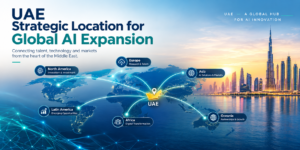
The 6-Hour Flight Radius
A single UAE base puts founders within roughly a 6-hour flight of major markets across Asia, Africa, and Europe — a genuine structural advantage for a startup planning to sell across multiple continents rather than a single domestic market.
Export-Oriented Thinking From Day One
The ecosystem and its incentive structures push founders toward planning for international scale early, rather than treating cross-border expansion as an afterthought once the home market is saturated — a meaningfully different default than startup ecosystems built primarily around a single large domestic market.
World-Class Connectivity Infrastructure
Underlying logistics and digital connectivity infrastructure supports both the compute-heavy demands of AI development and the practical logistics of running an internationally distributed business from a UAE base.
What Investors Are Actually Looking For
Alignment With National Strategic Priorities
UAE investors and government-linked programs respond strongly to startups whose focus intersects with declared national goals — AI adoption targets, digital government transformation, and smart city initiatives chief among them.
Technical Depth and Commercial Strategy
Funding tends to favor startups combining genuine technical depth with a clear, defensible commercial model — an “AI narrative” alone, without a credible product and go-to-market plan, is a weaker pitch in this market than headlines might suggest.
Highest-Conviction 2026 Investment Themes
Based on regional deal activity, AI applied to financial services and government operations, climate tech, digital health, and supply chain technology currently represent the strongest categories by deal volume and capital deployed — sovereign-aligned, mission-critical, and enterprise-procurement-friendly applications are outperforming generic consumer AI tools in this specific market.
A Balanced View: What to Verify Before Assuming This Fits Your Startup
Funding Concentration by Sector
Capital is heavily weighted toward AI applications in finance, government, healthcare, and logistics. A generic consumer AI app, without a clear enterprise or government angle, is likely to face a materially harder funding path here than a vertical-specific, enterprise-facing product — the regional data on sector concentration is stark enough that this isn’t a minor caveat.
Ecosystem Navigation Takes Real Effort
Founders who invest time in understanding the UAE ecosystem’s structures, relationships, and cultural dynamics tend to get outsized access to capital and networks relative to founders who arrive expecting the funding environment to function like Silicon Valley’s more transactional, cold-outreach-friendly norms. Those who skip this groundwork often underperform their own expectations, not because the capital isn’t there, but because access to it runs substantially through relationships and warm introductions.
Licensing and Tax Conditionality Still Apply
The same QFZP substance and qualifying-income rules that apply to any UAE tech company apply equally to AI startups. An AI narrative doesn’t exempt a company from standard compliance requirements, ongoing audit obligations, or the same licensing decisions every UAE tech company has to make.
How to Actually Break Into the Ecosystem
Key Events
GITEX Global — the region’s flagship tech and AI event, moving to a new December (7–11) slot at Expo City Dubai for its 2026 edition — along with STEP Conference (held each February at Dubai Internet City) and AIM Congress in Abu Dhabi (held each April), put founders in the same physical room as investors and ecosystem leaders. These aren’t optional networking extras in this market; a large share of warm introductions and early investor conversations trace back to in-person events like these.
Joining Accelerator Alumni Communities Before Applying
Talking to founders who’ve already been through a specific accelerator program before applying helps clarify what that program is actually looking for, versus what its public marketing suggests — application criteria and program focus shift year to year as priorities evolve.
Building a Visible Professional Presence
A well-maintained professional presence with genuine, substantive insight-sharing is commonly cited by founders and investors in this market as accelerating inbound introductions — the UAE’s startup and investor community is smaller and more interconnected than in larger ecosystems, which makes visible credibility carry disproportionate weight. This is exactly the kind of positioning and narrative work that a digital marketing agency for regulated-industry B2B branding specializes in, particularly for technical founders whose product expertise doesn’t naturally translate into the kind of public narrative investors respond to.
Frequently Asked Questions
How much AI startup funding did the UAE attract in 2025?
$519 million — 60% of the entire MENA region’s AI funding for the year, and a 267% increase from 2024.
What is Hub71 and how does it support AI startups?
Hub71 is Abu Dhabi’s flagship tech ecosystem, which has facilitated well over a billion dollars in funding for its resident startups over its history. Its AI-specific vertical, Hub71+ AI, provides AI-focused startups with funding support, compute credits, technical mentorship, and access to enterprise and government partnership pathways.
Does the UAE offer government grants specifically for AI startups?
Yes. The $500 million AI fund launched in April 2026 targets SMEs and early-stage companies integrating AI, and the Mohammed Bin Rashid Innovation Fund offers grants and low-interest loans to AI-integrating SMEs more broadly, alongside sector-specific accelerator funding.
Is the UAE’s AI funding advantage available to any type of AI startup?
Not evenly. Capital is heavily concentrated in AI applications for finance, government, healthcare, and logistics. A generic consumer AI product without an enterprise or government angle will likely find this a harder market than the headline funding figures suggest.
What tax benefits apply to AI startups in the UAE?
0% personal income tax applies universally. On the corporate side, 0% corporate tax applies to qualifying free zone income for companies that maintain Qualifying Free Zone Person status; a standard 9% rate applies above AED 375,000 for non-qualifying income or mainland companies.
Final Thoughts
The UAE’s AI funding growth and government backing are real and substantial — this isn’t manufactured hype. But the advantage is strongest for startups aligned with national priority sectors (finance, government, healthcare, logistics) and for founders willing to actively navigate a relationship-driven ecosystem rather than expecting capital to arrive through cold outreach alone. It isn’t an automatic tailwind for every AI idea. Map your specific application against the UAE’s stated priority sectors and target a specific accelerator or fund rather than defaulting to a generic “set up in Dubai” approach — and get the underlying structuring decisions right early, since licensing and tax choices compound over a startup’s life. A virtual CFO consultancy in Dubai can help model those decisions before your first funding round rather than after. If you’d like help thinking through the right structure and positioning for your specific AI application, our team is happy to talk it through — and for the underlying legal mechanics of company structuring itself,this overview of UAE regulatory law is a useful starting point, alongside broader context on the UAE’s growing tech and business ecosystem for founders still scoping which vertical to target.
Sources
This guide draws on MAGNiTT’s 2025 State of Venture Capital in AI (MENA) report, Hub71’s published program data, UAE government announcements on the 2026 AI fund, and independent regional venture trackers, reflecting figures current as of September 2026. Funding totals, fund sizes, and accelerator terms change frequently in this fast-moving niche — always verify current figures directly with the relevant fund, accelerator, or government body before making decisions based on them.
- MAGNiTT — magnitt.com
- Hub71 — hub71.com
- UAE Ministry of Economy
- Precedence Research — UAE AI market data